HOUDINI CONNECTIONS
MAIN TOPIC - Extreme sports?
ENDURANCE TRAINING
Part two (under construction)
This is where it gets a bit more psychological.
The subject of demanding training in a conventional sports situation,
when taken one small step further might be called torture
by people who don't understand this sort of thing.
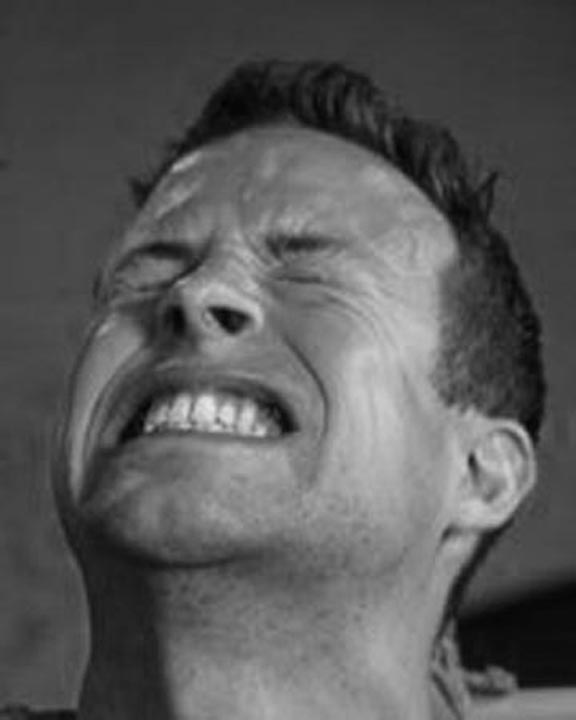
DEAL WITH IT is the order of the day in any activity, when learning to stay focused no matter how tough the going gets.
This applies in many athletics situations. Training towards this, whether self-motivated or driven, involves getting used to it (whatever 'it' might be) and rising above it.
When rugby players are ordered to sit on the ground in the rain, and are then told to scoop up mud and shove it inside their shirts and shorts before continuing training practice, this is not some sort of 'kink' oriented event - or is it? There is a valid point to the exercise. Not being distracted by such physical discomfort comes only with deliberate conditioning.
Ignoring well landed punches in boxing and concentrating on finding openings; staying the course on gruelling runs or climbs in spite of minor mishaps; keeping alert when cold and exhausted until the objective is achieved ... all demand repeated exposure to the experience.
The reward is the exhilaration of achievement. Learning to live with whatever comes with the territory can bring great satisfaction. Self-testing in the face of challenge remains the name of the game - whatever form of conventional or unconventional 'Extreme Sports' appeals to your innermost (and sometimes instinctive but un-focused) needs. The question remains - how far is too far - and when is enough not enough?
TESTING LIMITS
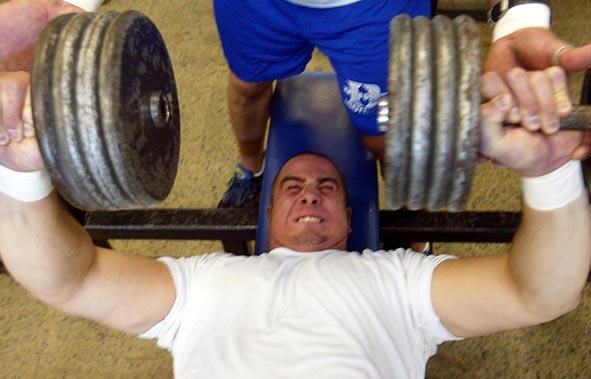
Ability to withstand can be systematically built up, but usually through the determination of everybody involved. For the receiver, dealing with the physical (and sometimes mental) stress can be far from enjoyable at the time - but is something they wanted to experience - and can be very rewarding to have survived.
THE CAPACITY TO ENDURE
The means by which such conditioning is carried out may appear, to somebody not 'into' this type of activity, to be physical abuse. In fact British law does not permit an individual to allow / invite certain forms of what others would see as abuse.
The whole topic of consent is given a lot of space elsewhere on this site.
Discussion of interrogation techniques, some people find distressing while other are fascinated to know not only how it might be achieved - some want to know what it would feel like when subjected to it.

WHY DO IT?
This is a question I've never spent a lot of time asking myself. There have been many times when I've asked myself why the fuck I was doing whatever physical challenge I was subjecting myself to. Sometimes best not to question too closely - either do it or don't!
Often, elements involved in a particular activity dictate what appeals. Wrestling as distinct from boxing, mountain climbing rather than pot-holeing, wind-surfing rather than hang-gliding? The gear and the people who pursue a particular leisure activity may be what influence the personal choice. The attraction may be conscious or subconscious. The main point here is - if it pushed certain buttons in your brain, don't stop to analyse it too closely. Opportunity to experience it more often and more fully should be the aim. Then, take it or leave it - but don't knock it till you've tried it - twice. To hell with how weird other people may find the activity - do it to whatever degree is right for you.
If you feel you need a driving force - it's all in the details.
Any individual who is willing to enter into a forceful training regime may wish to establish a few ground rules in advance. But, to set too many limits (between players who know one another well) can limit the mutual enjoyment
FORCED TRAINING
Previous discussion of degrees of 'enforcement' during training touched on Authority Figures and their role in making sure the required effort is put in. Encouragement can take many forms.
A carrot and stick approach is often considered necessary. Particularly in a toughening-up process, the incentive to keep working at it may need to be a balance of encouragement and threat.
A ruthless insistence may need backing up with some form of penalty.
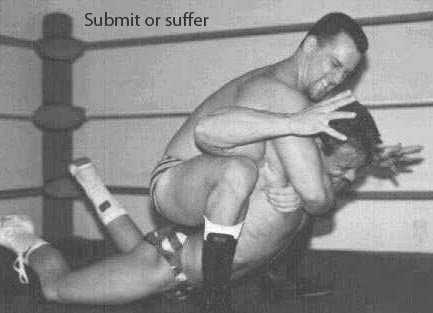
SUCCEED OR SUFFER.
When learning to tough it out, extra effort can be encouraged by knowing what failure to achieve might involve. In team and one-to-one competitive situations winners need some form of reward, losers need an incentive to try harder next time. The price of failure is sometimes very imaginatively conceived in sporting circles.
A range of descriptive examples is already scattered around this site.
Team-mates punishing a member who screwed-up often takes it's form from the type of sport. Group games can lead to capture of the opposing team, the advantage being demonstrated in some humiliating way.
Ruthless trainers may deliberately push trainees hard enough to provoke a counter-attack, almost inviting attempts to turn the tables or take revenge.
Submission wrestlers may agree in advance that a forfeit will be demanded of the loser.
For both winners and losers, the chance to devise or experience even more challenging physical predicaments is justified in the context of succeed-or-else.
Paying the price of failure

The Academy
Try harder next time

PREDICAMENT CHALLENGES.
The very nature of physically active men in competition can lead to wanting to both devise and perhaps experience 'punishing' situations. A winner-calls-the-shots agreement can offer great incentives to a certain type of individual when in competition.
Scenarios for imaginative extensions of any challenge situation often depend on the nature of the activity,
the gear involved and the adrenalin rush of opportunity to strive towards a point of physical dominance.
Wrestlers each having a length of rope and wrestling until one of the pair is incapacitated by use of both pieces of rope, for example. Perhaps a sub-index of 'winner calls the shots' scenarios is needed. (I'll work on it)
For some game-players, the punishment for failing to achieve provides incentive to come out on top ... OR ... by failing, invite additional opportunity to practice endurance. FAILING BY CHOICE in a challenge situation is a complicated topic.
Practical and technical considerations can make planning any challenge event mind-stimulating. The actual putting into practice of stressful physical predicaments and imposing them on somebody else (such as spread-eagle, hog-tie or burying-up-to the neck-in-sand) can involve various practical skills and organisational abilities as well as imagination. This topic is explored in a separate file which is under construction. MORE
The ingenuity demanded of the doer then needs to continue while keeping up the pressure throughout whatever the continuing 'challenge' might be.
SPORTING AND UN-SPORTING
Ruthlessly enforced conditioning to enable somebody to deal with uncomfortable situations happen in sports circles ... but also in real life occupations.
Army training inevitably involves a degree of duress. Crack fighting regiments need ruthless training as part of the toughening-up process. To avoid being distracted by cold and wet conditions, troops (as well as Rugby players) are often systematically forced to work in the rain, crawl through mud in full kit. Punishment for failing to respond to such training can involve press-ups into mud, perhaps while wearing a heavy army back-pack to intensify the experience.
Fire-fighters need to be trained to deal with choking smoke by experiencing it. Divers in training are made to find their way through underwater hazards, sometimes with their hands tied behind their backs.
Such experiences repeated in training, serve to make future real-life challenges easier to deal with.
Rough-house barrack room antics invite opportunities to practice skills newly learned. Bar room brawls, punch-and-get-punched episodes result from enhanced ability to give and take.
Pride in achievements sometimes leads group members to self-test among themselves.
To achieve the tough facial features of a ‘hard-nut’, a tradition of SLAPPING in certain fighting regiments, requires men in training to sit opposite a fellow trainee and repeatedly flat-hand slap the other’s face hard. This is a version of ‘milling’, a tradition devised by British army physical training instructors as punishment for barrack room fights. Miliatary discipline requires the two feuding opponents to remain standing toe to toe and hit one another with padded-gloved hands, punch for punch for a fixed time.
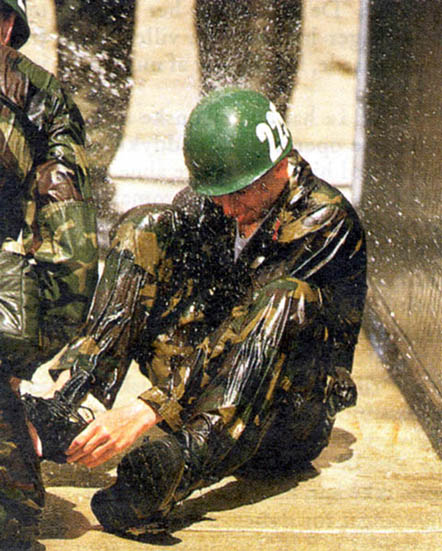
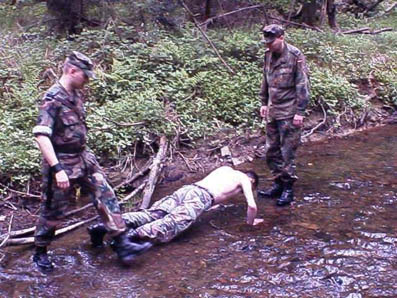


Courses in ‘Resistance to Capture and Interrogation’ in serving regiments can include being subjected to techniques for softening up as a form of toughening up.
STRESS POSITIONS designed to weaken resistance are, on occasions, practiced in training. Being forced to hold positions designed to quickly cause muscle stress need to be experienced so they can be endured to an intense degree if encountered later.
Such situations can also hold an attraction for civilians of a certain type: men who can never resist a challenge. Learning to apply such techniques my only be achieved by experiencing them. Both side of this coin are enjoyable fantasy for many a would-be player of 'extreme sports'. Encouragement to create pportunities to be tested and to test others is what this site is all about.

Self-testing by building up an ability to survive physically uncomfortable situations is not everybody’s idea of a hobby. But for those with a particular attraction to a specific dramatic scenario, creating such opportunities and then sharing the responsibilities of forced training can offer a world of creative challenge.In addition, not only the ‘done-to’ and whoever will be applying the pressure ... it can be highly stimulating for anybody who is allowed to see the photos or read about it afterwards.
WHATEVER TURNS YOU ON
Via the search engine at the bottom of the INFORMATION BANK page,
type in your own buzz words to see what matches you discover on this site.
Scenarios which describe what real-life players are able to achieve for themselves
would fill a book.
The book MORE AND HARDER if you can find a copy, is a case in point.
(check it out on E-bay)
On this site, many physically challenging predicaments are described in graphic detail
under the STORYLINES heading.
LINKS TO TOPICS MENTIONED ON THIS PAGE
Group game-playing
Consensual non-consent
Interrogation (general questioning)
Resistance to Interrogation & Torture
Toughguy web site
British Combat Association web site
(add links to other organisations sites)
return to
SPORTS INDEX
for other related material about sportsmen pushing boundaries
The Callum Buchanan sequence of files continues with
SPORTS GEAR AS RESTRAINT
self-applied bondage session described in detail