HOUDINI CONNECTIONS
TOPIC -
Sportsmen self-testing
ENDURANCE TRAINING
for game-players
(part one)
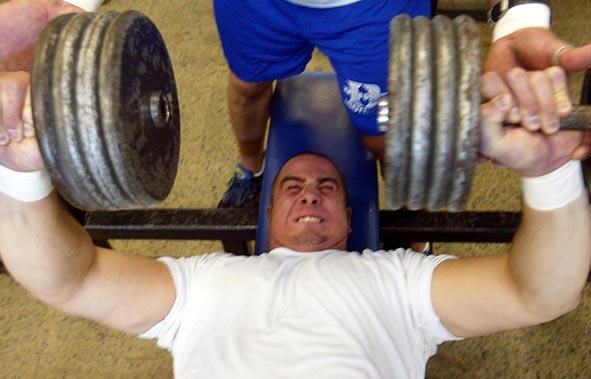
The topic here is willingly accepted body stress; self-conditioning to withstand physical challenge.
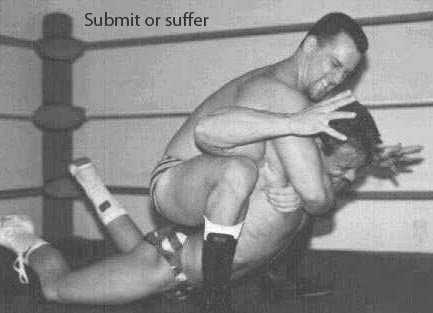
The choice to submit to punishing training is not considered strange by boxers, wrestlers and people who enjoy strenuous competitive sports. Self-induced body stress to a painful degree is, in many instances, all part of the game.
Masochism is a word most sporting types don’t like to hear, but in both training and performance, pain thresholds are something to reach and then push beyond. Learning to deal with such demands on the body usually involves repetition. Building up this stamina calls for ruthless self-discipline or challenge from training partners. Sessions of willingly endured painful body stressing are easier to deal with when driven by a demanding trainer. Proving to yourself that you can deal with it can be rewarding ... but having somebody to encourage while at the same time having authority to insist during training, is the real topic under discussion here.
To endure pain just for the hell of it can be a pointless exercise but in competition, a provocative challenger can be highly motivating. In more strenuous conventional training situations, the question is not just how far you are prepared to allow yourself to be pushed: are you willing to give somebody permission to insist that you continue after you've had enough?
Depending on the demands of a particular 'sport' the physical conditions may differ, but toughing-up to withstand ‘whatever’ usually involves not only self-commitment but a willingness to be pushed - and pushed hard.
Such self-testing is a form of rewarding self-indulgence but sometimes fantasy fulfilment is part of it.
AVAILABLE ALTERNATIVES
The circumstances in which stressful challenges take place can add extra factors: gym-based, at home or out-of-doors, team based or one-on-one.
In physically demanding outdoor activities, where weather conditions can add to the dynamic, several different sorts of supervised self-testing are on offer. Survival courses and so-called Adventure Training in groups can serve to build up resilience and provide opportunities for getting used to withstanding punishing out-door experiences. Peer group pressure can be the spur, or through buddy training (two people determined to match one another's achievements).
But for some men, the challenge of being pushed is not only needed - but enjoyed.
Socially acceptable extreme self-challenge situations in public are catered for in Britain by several reliable Organisations. Not all are exclusively dedicated to recognised conventional sports events.
“Extreme sports” is a term used to cover a multitude of physically challenging variations (if not deviations) from the norm.
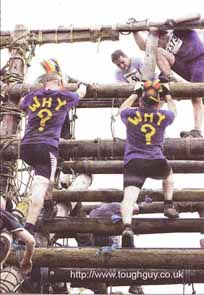
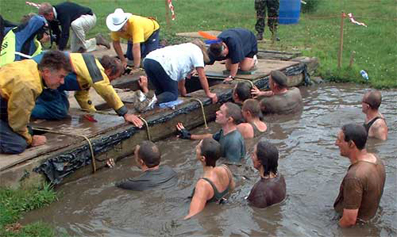
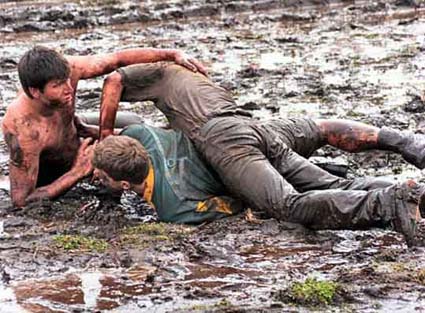
Spectators regularly enjoy watching the fiercely demanding TOUGHGUY events, where rugged individuals submit themselves to devilishly devised assault course situations. Contestants often bring along wives and families to watch them compete in self-testing mucky and muddy pursuits (3 photos right - link to their site at the end of this page).
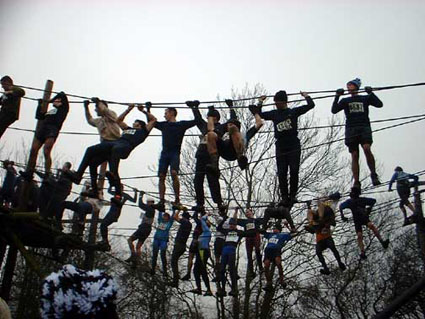
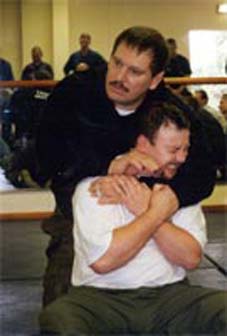
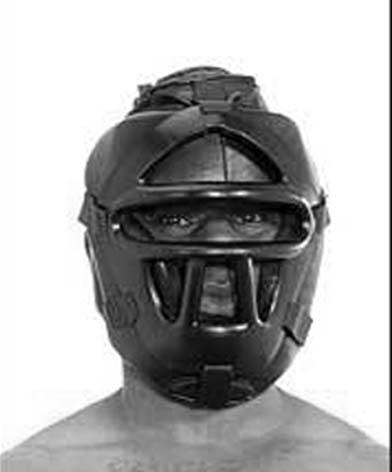
Gyms and sports clubs often have their own by-invitation-only groups when members push the boundaries of training, and indulge in spin-off high-energy activities.
But opportunity to let off some steam with a socially acceptable pretence of good clean fun, aren't always easy to find. In all walks of life, active hard-men are on the lookout for like-minded individuals who might share their particular idea of what's acceptable when it comes to self-testing.
On this page the focus should remain on the personal need to be ‘pushed’, in order to discover whether physical endurance game-playing is as rewarding in reality as it is in your private fantasy.
PROVOCATIVE TRAINING
In a demanding driving force situation, well defined roles can add a necessary edge.
The psychological balance between the want-to-be-challenged and the challenger can be a matter of choice, but once pre-determined ... that's where the power lies.
In other areas of the ‘Houdini-connections’ web site, different sorts of Authority Figures offering different levels of control and resistance to control, are discussed.
Here we’re focusing on shared opportunity to prove oneself: to experience physical discomfort or pain, and take pride (delight) in achieving. Perhaps the aim is to build up extra strength of body and mind - perhaps just for the hell of it.
Various scenarios described on this site can be exhilarating for everybody involved in the exercise. Creative imagination when devising challenges helps, especially when the challenger/trainer is intent on generating the necessary intensity. Surprise is another useful element.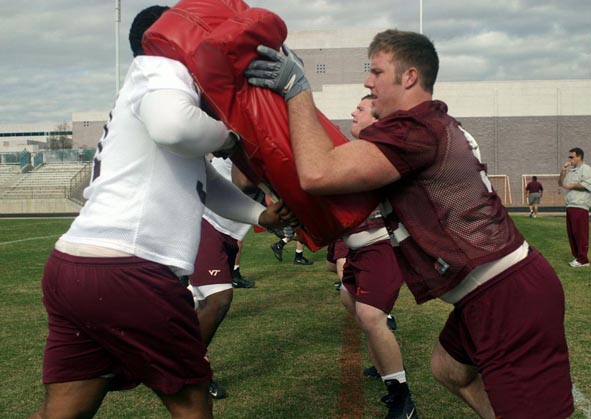
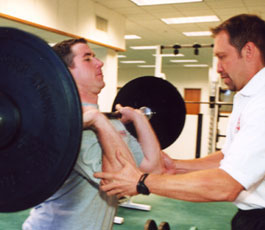
ROLE REVERSAL can also be a factor, when the trainer and the one being trained change places occasionally or on a regular basis. Pay-back opportunities after a punishing session can provide a useful safety mechanism.
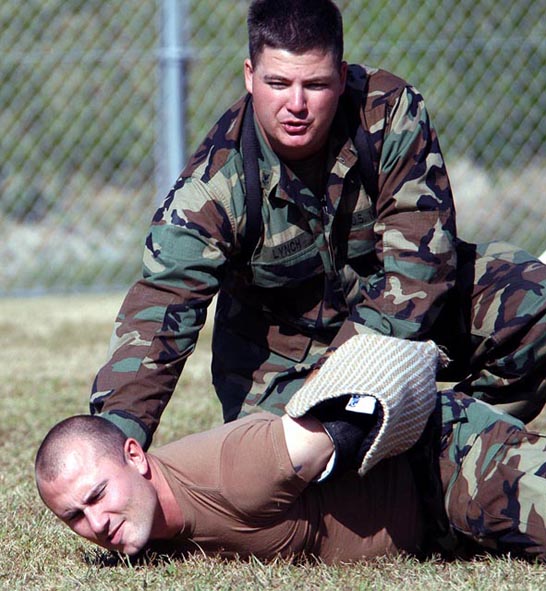
Certainly, games of this type are more rewarding when played by well-matched players.
The ingenuity of the challenger in competition with the determination of the person being challenged to rise to the occasion, can add zest to any such situation.
Unexpected scenarios and even some role play are useful when creating a seriously realistic degree of authority. An extra edge can be added when there is some resistance to the demands being enforced.
When both players enter into the spirit of a relentless believable scenario, a high level of intensity can be achieved during 'training'. Just how harsh, demanding or painful the interaction becomes is a matter for the individuals involved.
Pushing boundaries and testing can be a stimulating challenge to all parties; whether giving, taking - or observing.
PRE-AGREEMENT between players in terms of what is acceptable and what isn’t, is a subject dealt with elsewhere on this web site. ‘Limits’ when it comes to degrees of consent during forceful challenge is a sometimes confusing topic for people new to such competitive game-playing. “Consensual non-consent” is not an ideal title for such a complicated concept (see end of this section for links to extended notes on this topic). In a nut shell, it means agreeing to surrender all choice at some point, giving a trusted individual permission to take and keep total control, with a NO BACKING OUT clause in force once the agreed upon game has started.
A certain type of person wishing to test himself “beyond endurance” - perhaps knows that, after a certain point, he will need to be pushed. Surrender of ALL responsibilities for what happens and inviting what is, in effect, physical force may be technically illegal. The “OK, do-your-worst” challenge is a very appealing concept in a lot of people’s imaginations.
But before turning this into some sort of reality, ground rules need to have been established in advance.
In creative control and counter-control game-playing, even when the most extreme sounding kidnap or resistance to interrogation fantasies are planned, certain mutually agreed limitations are already implicit in the established relationship between players.

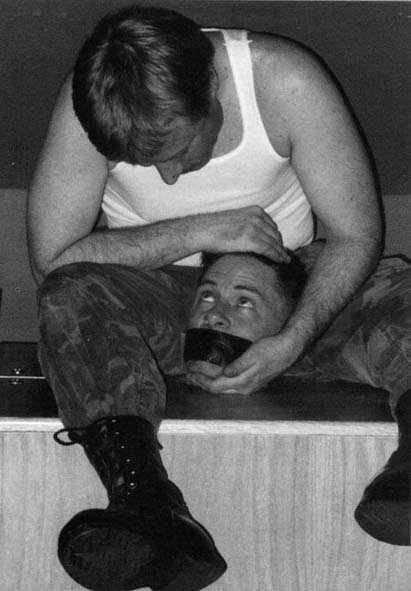
MUTUAL AGREEMENT is a must in all such scenarios however one-sided they may eventually become by design.
Once the game is in progress, the challenger knowing when to push harder and when to ease up; or knowing how far might be too far but also when not going far enough can be disappointing for the person wanting to be challenged, are important factors. When prior permission is given for forceful insistence in a planned training or testing situation, the ground rules need to be fully understood by all involved. Clear communication is a must when any such agreement is entered into.
Even so, pre-agreed limits can only be rough guidelines. The dynamic of any situation will depend on a certain amount of playing-it-by-ear. The person in control being able to read signs; knowing when “No! Please stop!” doesn’t mean stop but perhaps means ease up a bit. Alternatively, such a reaction might be deliberate testing of the authority figure to find out if he will keep pushing as promised.
Feed-back and de-briefing discussions after any challenging play-session can also be valuable to make sure that future get-togethers will be more rewarding for both players.
I keep using the ‘game-playing’ terminology because, although at times the action may become seriously demanding (and painful), the fact remains that all interactions are willingly entered into on a basis of trust.
Just as in sparring or wrestling practice, the level of physical intensity in endurance training needs to be carefully judged by the person driving the session. In games where some degree of physical restraint is being used, the responsibility of the challenger needs to be matched to the ability of the person who has agreed to be challenged, to be able to communicate clearly before and during.

Having said that, situations in which ability to communicate is removed by a gag or coverings are not unusual in what some people call 'Extreme Sports' situations.
Many people particularly relish such opportunities to experience total absence of power or have any say in the matter. Freedom to complain and resist and knowing that such complaints will be ignored, brings it’s own kind of exhilaration.
Such circumstances should only be entered into with partners who have earned trust in previous sessions ...
... but, this degree of intensity can be very rewarding ... even if enjoyable only after the event is over.
'EXTREME SPORTS' ?
Many situations described on this site are challenge and be challenged, control and counter-control taken to extremes. Under the 'Storylines' heading, there are descriptions of scenarios which might blow the minds of players of conventional sports - or widen horizons - whet appetites.
But, whatever the level of intensity, the games described are mainly based on achievable real-life experience. Also, any challenge described was devised by mutual agreement and was willing entered into ... even when part of the agreement was the luxury of being able to surrender all control over the outcome ...
... with the proviso that, at some future point, the tables may be turned.If the topic interests you - there is more at
ENDURANCE TRAINING 2or return to the SPORTS INDEX
LINKS TO TOPICS MENTIONED ON THIS PAGE
Group game-playing
Consensual non-consent
Interrogation (general questioning)
Resistance to Interrogation & Torture
Toughguy web site
British Combat Association web site
(add links to other organisations sites)
return to HOME PAGE